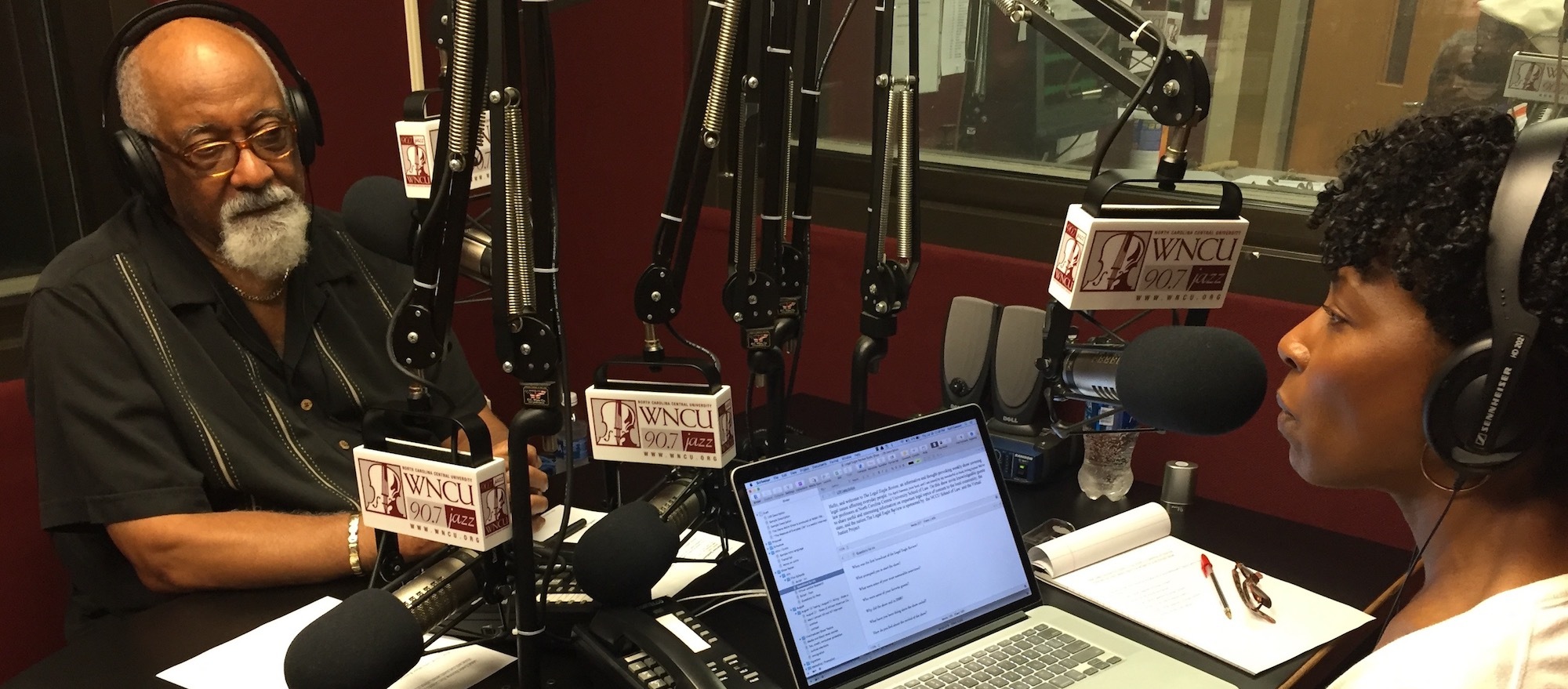
The Legal Eagle Review is an informative and thought-provoking weekly radio show and podcast where the show hosts, NCCU law professors Irv Joyner and April Dawson, talk with guest experts and discuss current legal and political issues affecting everyday people in Durham, the surrounding community, and the state. The show airs on WNCU 90.7 FM on Sundays from 7-8p. The Legal Eagle Review is sponsored by the North Carolina Central University School of Law, and the Virtual Justice Project.
Episodes
Jul 28, 2019
Jul 28, 2019
56 min
In 1971, the noted philosopher Marvin Gaye recorded a blockbuster song, What’s Going On, which captured the political mood of a large portion of Americans and the vast majority of African Americans. Today, we find a similar mood in this country as many people question the State of Democracy and whether the political process is being abused and misused.
As we move toward the 2020 elections, we take the time tonight to talk about an assessment of “what is going on” with respect to the actions of elected officials as they affect the rights and expectations of people. As we sit here today, there are ongoing discussions of efforts to impeach Donald Trump as President, there are widening use of racist antagonisms within the political process, and there are alarming and escalating attacks upon established political institutions and protections.
Joining us tonight to discuss this topic is the NCCU resident political science expert Dr. Jarvis Hall, a Professor in the NCCU Political Science Department. We want to thank you for taking time from your busy summer schedule to participate in this discussion.
Jul 21, 2019
Jul 21, 2019
57 min
On October 1, 2018, the first Monday in October last year, the U.S. Supreme Court began its most recent term. On Thursday, June 27, 2019, the Court issued its final decisions of the term. During this show, we’re going to talk about some of the major cases from the Supreme Court’s term and their implications. Joining us for this discussion are NCCU Law Professor and Associate Dean Malik Edwards and NCCU Law Professor Don Corbett. Both Professors Edwards and Corbett teach a number of courses including Constitutional Law.
Jul 14, 2019
Jul 14, 2019
59 min
Juneteenth, which is celebrated on June 19th, recognizes the issuance of the Emancipation Proclamation on January 1, 1863, and the official conclusion of the Civil War on May 13, 1865. This celebration date results from the arrival of General Gordon Granger in Galveston, Texas on June 19, 1865, and announced to the inhabitants that slavery had ended. June 19th became the symbolic day for the celebration of the end of slavery following celebrations which began in Texas in 1866. As a holiday, Juneteenth is now celebrated in forty-five State and in the District of Columbia. Slavery exacted a tremendous toll on enslaved Africans and upon their descendants. For generations, Africans were forced to provide free labor for Whites and were subjected to the most brutal and degrading treatment imaginable. An increasing number of people have joined in efforts to demand Reparations for the many years of forced labor endured by the ancestors of African Americans. Many also advocate for compensation for the official sanctioned oppression and dehumanization which were inflicted upon African Americans during the “Jim Crow” era, which lasted from the late 1890s up until 1970s. By every measure, the impacts of slavery and “Jim Crow” continue to negatively impact African Americans and are the principal causes of the huge wealth gap which presently exists in the United States between Africa Americans and whites. On this show, we discussed Juneteenth and Reparations with Dr. Sandy Darity, the Director of the Samuel DuBois Cook Center on Social Equity at Duke University and Dr. Keisha Bentley-Edwards, an Assistant Professor of Medicine at Duke University and the Research Director at the Cook Center for Social Equity.
Jul 7, 2019
Jul 7, 2019
58 min
In 1969, a little over 50 years ago, Shirley Chisholm was sworn in as the first African American woman to serve in Congress as a congressional representative for Brooklyn, NY. Since that time, African American women have made significant gains in politics. However, even though African American women are being elected in record numbers (at a rate that has outpaced African American men), it is still difficult for African American women to secure high-profile offices at both the state and national level. And while the Black female electorate is recognized as a valuable voting block, many of the issues that are of particular importance to Black women are still the most likely to be overlooked when elected official make policy-making decisions. On this show, we discussed African American women in politics with Chief Justice Cheri Beasley, the first African American woman Chief Justice of the North Carolina Supreme Court; Jessica Holmes, Attorney and Chair, Wake County Board of Commissioners, and a candidate for NC Commissioner of Labor; and Erika Wilson, Law Professor at UNC-Chapel Hill School of Law.
Jun 30, 2019
Jun 30, 2019
59 min
HB 370 has been introduced in this session of the North Carolina General Assembly and is presently being considered by the State Senate. If passed and signed into law by the Governor, HB 370 would require that every elected North Carolina Sheriff to fully cooperate with the U.S. Immigration and Customs Enforcement (ICE) when ICE officials believe that an arrested person has entered the country illegally. The bill would require that Jail Administrators allow ICE Officers to interview any person within the County’s custody upon request for it to be determined if an ICE warrant has been issued for that person. If a warrant has been issued, the Administrator must take that individual before a County Magistrate to seek authorization for that person to be held in jail until ICE officers can take the person into federal custody. If the Sheriff fails or refuses to comply with this directive, the Sheriff can be removed from office. This legislation has drawn opposition from many Sheriffs, legislators, civil rights organizations, lawyers and citizens on the grounds that it is unconstitutional and counter-productive. On this show, we discussed the problems with this proposed legislation with Sheriff Clarence Birkhead of the Durham County Sheriff Department and Ivan Almonte, a Durham Community Activist and partner with Bull City Lawyer.
Jun 23, 2019
Jun 23, 2019
58 min
The current structure of the North Carolina criminal justice system routinely imprisons people for no reason other than their inability to pay a court-imposed debt. And the failure to pay often results in the imposition of even more fines, which results in greater debt and hardship. Our criminal justice system treats poor people more severely than those with means, causing poor people to suffer greater criminal consequences than those with means who commit the same offenses. On this show, we talked with Laura Holland, Staff Attorney at the NC Justice Center, and Quisha Mallette, Community Advocate for Reinvestment Partners, about the extreme challenges faced by low-income people in dealing with the criminal justice system in North Carolina, and how the system has resulted in the criminalization of poverty and the unequal treatment of the poor in this state.
Jun 16, 2019
Jun 16, 2019
59 min
Juneteenth, which is celebrated on June 19th, recognizes the issuance of the Emancipation Proclamation on January 1, 1863, and the official conclusion of the Civil War on May 13, 1865. This celebration date results from the arrival of General Gordon Granger in Galveston, Texas on June 19, 1865, and announced to the inhabitants that slavery had ended. June 19th became the symbolic day for the celebration of the end of slavery following celebrations which began in Texas in 1866. As a holiday, Juneteenth is now celebrated in forty-five State and in the District of Columbia. Slavery exacted a tremendous toll on enslaved Africans and upon their descendants. For generations, Africans were forced to provide free labor for Whites and were subjected to the most brutal and degrading treatment imaginable. An increasing number of people have joined in efforts to demand Reparations for the many years of forced labor endured by the ancestors of African Americans. Many also advocate for compensation for the official sanctioned oppression and dehumanization which were inflicted upon African Americans during the “Jim Crow” era, which lasted from the late 1890s up until 1970s. By every measure, the impacts of slavery and “Jim Crow” continue to negatively impact African Americans and are the principal causes of the huge wealth gap which presently exists in the United States between Africa Americans and whites. On this show, we discussed Juneteenth and Reparations with Dr. Sandy Darity, the Director of the Samuel DuBois Cook Center on Social Equity at Duke University and Dr. Keisha Bentley-Edwards, an Assistant Professor of Medicine at Duke University and the Research Director at the Cook Center for Social Equity.
Jun 9, 2019
Jun 9, 2019
59 min
North Carolina is no stranger to the opioid crisis sweeping the nation. In this State alone, from 1999 to 2017, more than 13,000 North Carolinians died from opioid overdoses. In 2017, five North Carolinians died each day from unintentional opioid overdoses. In that year, more than 521 million opioid pills were dispensed to North Carolina residents. The death rate attributed to opioid overdoses rose from 116 in 2013 to almost 2,000 in 2017. Among African Americans, the rate of increase in these overdose deaths is higher at the national level even though the actual use of opioid by Whites is higher. The Centers for Disease Control and Prevention reported that 5,513 African Americans died from opioid overdoses in 2017, which represented an increase of 26% over the 2016 number. In this show, we talked about the opioid crisis with Attorney Hugh Harris, Outreach & Policy Counsel for the Public Protection Division of the North Carolina Department of Justice and Dr. Jennifer Carroll, Professor of Anthropology at Elon University.
May 26, 2019
May 26, 2019
58 min
The United States Constitution requires a census of the American population every ten years. Therefore and for many reasons, getting an accurate count of the United States population is important each decade. An accurate count of the United States population is used to determine how many U.S. Representatives a state will receive and the amount of federal funds provided to each State. Census data is also used to draw congressional and state legislative districts. In light of the mobility of the American population, it is critical that the census is regularly taken and that the results present an accurate as possible count for each State. On this show, we talked about the need for accurate census data with Stacey Carless, Executive Director of the N.C. Counts Coalition, and Juliana Cabrales, Mid-Atlantic Director of Civic Engagement for the National Association of Latino Elected Officials Educational Fund.
May 19, 2019
May 19, 2019
59 min
Hip Hop first made its appearance on the scene in the 1970s, when black and brown kids in the Bronx began spitting lyrics to popular songs. Today, Hip Hop is the most consumed genre in American. And the demand is reflected in record sales here in the United States and worldwide. Hip Hop has influenced American politics and culture and has also been influenced by the American legal system. On this show, we talked about the law through the lens of hip hop with NCCU Law professor Todd Clark.